
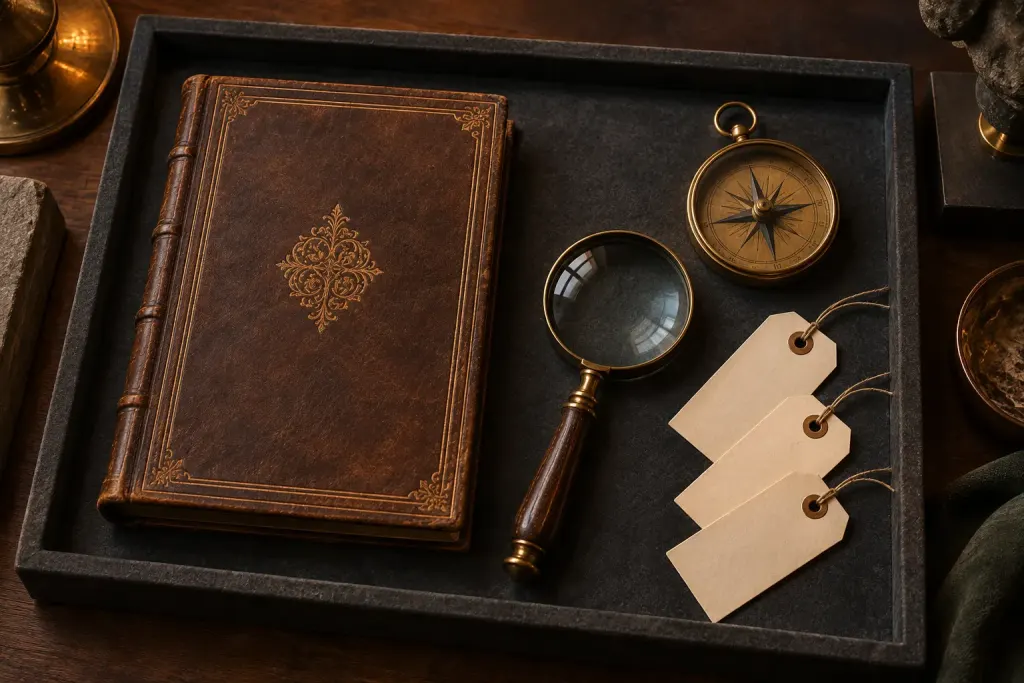
A museum search result may offer a striking photograph and a short title. Both are good invitations to look closer. Neither is the whole record. The less conspicuous details—an identifier, a date range, a qualification beside an attribution—are often what let you use the record responsibly.
This matters when reading the history of arms, armour or sporting equipment. Similar names can cover different objects, while one object may have appeared under more than one description over time.
Keep the identifier with the title
Royal Armouries explains that its online collection uses different museum-number formats for objects, archive records and library resources. Its guide also describes searches and filters across those kinds of material. The practical lesson is to preserve the complete identifier rather than relying on a memorable title alone.
Write the institution, identifier and direct record link on the same line. If you later find another entry with a similar title, you can check whether you are looking at the same object, a related item or a separate resource.
Copy the uncertainty, too
Words such as “attributed”, “probably” or a date range are part of a description’s meaning. Do not silently remove them when turning a record into a caption. A more definite sentence may sound smoother while saying more than the source supports.
For a fictional example, “case, maker uncertain, around 1900” should not become “made by the named workshop in 1900” merely because a neighbouring entry names that workshop. Keep the uncertainty attached to the particular object.
Give each field its own question
A date may describe manufacture, a depicted event or a later addition. A name may identify a maker, owner, donor or subject. Ask what role the field actually plays in this record. If the page does not explain it, avoid filling the gap from intuition.
Photographs need the same care. Describe what is visible without treating a view of one side as a complete examination. An online image is a route into research; it does not make the reader a conservator or authenticate a similar object elsewhere.
Make a note another reader can follow
Finish with a compact record: institution, identifier, title, stated date, stated attribution, link and access date. Beneath it, add your own question. Keeping source information above interpretation makes the boundary easy to see.
Then look for context in a catalogue, archive or published study. Our guide to following a paper trail explains how different documents can answer different parts of an object’s story.
Reference: Royal Armouries, Guide to Collection Online. This is a reading method, not an appraisal or an authentication service.