
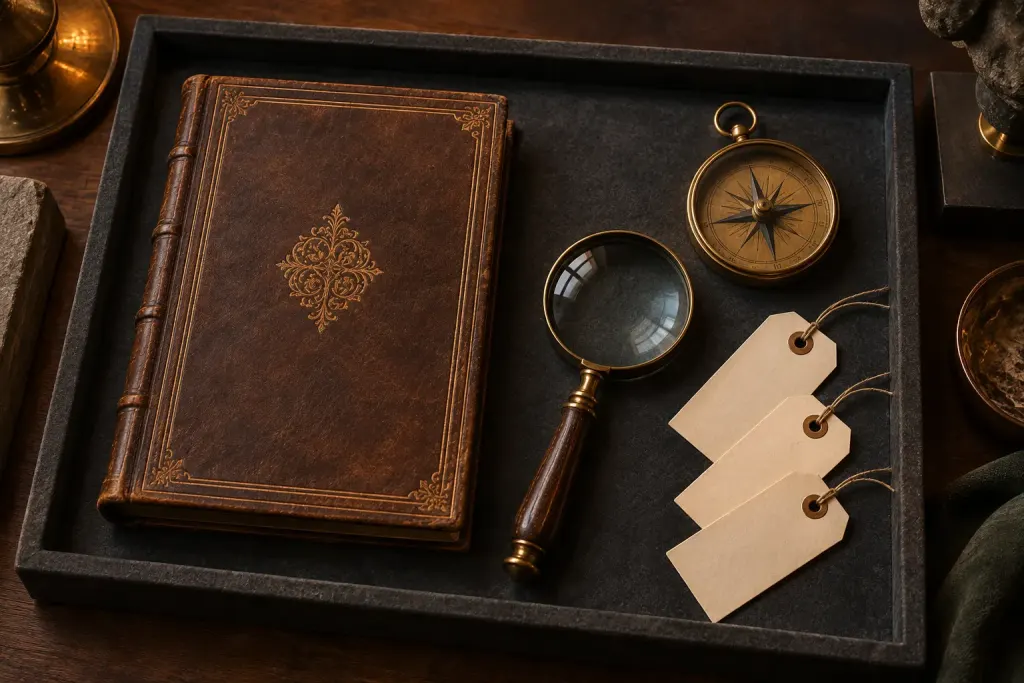
A box may be described by its colour and decoration while the small joint that allows it to open goes unmentioned. Giving the hinge a separate line changes the question from “what does this object look like?” to “how are its parts related?”
Use an object you own and can safely inspect, or a museum record with several views. First identify the two parts joined by the hinge. Describe their positions with the object closed and, where documented, open. Do not force movement in a museum object or a fragile possession.
A practical description
For a hypothetical modern storage box, write: “The lid is connected along the rear edge by two small hinges.” This says more than “a hinged box” without pretending to know the alloy or manufacturing method.
Next ask what the photograph does not show. Are the fasteners visible? Is the opening angle documented? Does a dark patch reveal a separate component, or could it be a shadow? Leave those distinctions unresolved when the image cannot answer them.
If a catalogue identifies a replacement hinge, cite that record when discussing repair. A different colour alone is insufficient evidence that the part was replaced.
This small descriptive habit is useful for cases, folding furniture, instruments, and packaging. It keeps a working relationship between parts in view, even when the object’s decorative surface is what first attracted your attention.