
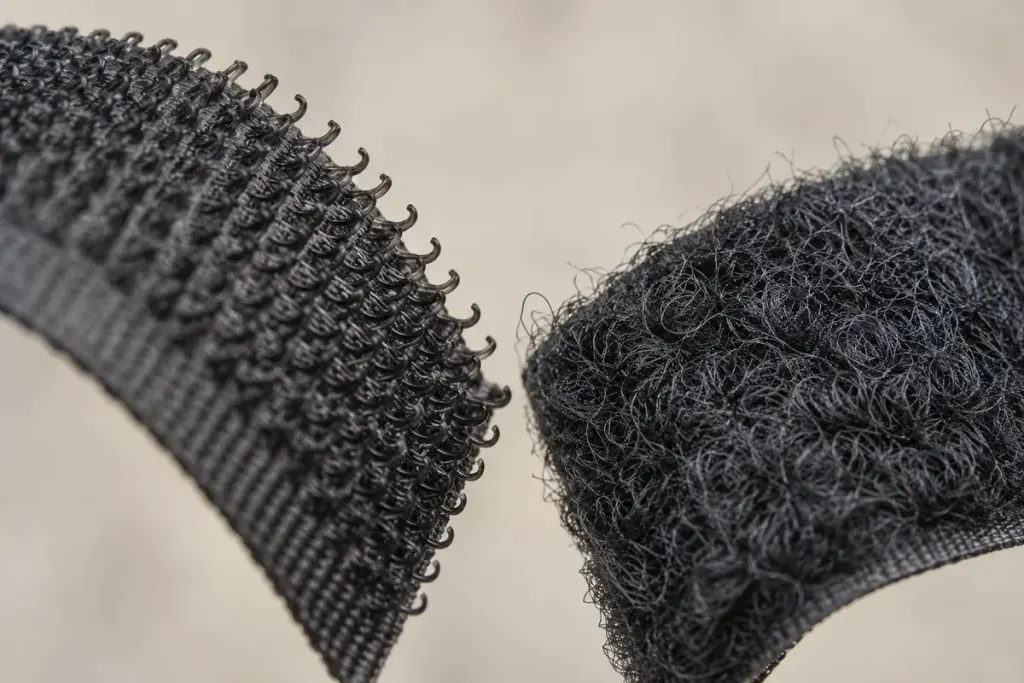
A jacket cuff closes with a brief scratchy sound. A cable strap uses a similar fastening idea, but bends back around itself. The everyday name may be familiar enough that we stop looking at the object. A closer description begins by separating the two surfaces that meet.
One side carries small hooks; the other offers loops that those hooks can catch. Velcro Companies’ explanation of hook-and-loop fastening shows the mechanism and distinguishes the generic fastening system from its VELCRO brand. A familiar brand name alone is not evidence of who manufactured an unlabelled strap.
Look at the working surface and the attachment
Choose an ordinary object you own and can inspect without damage. Identify which patch is the hook side and which is the loop side. Then look at how each patch joins the object. Is it stitched, bonded or incorporated into a strap? The face that grips its partner and the backing that holds it to the product have different jobs.
For an illustrative catalogue note, compare “black Velcro strip” with “black hook-and-loop cuff closure; rectangular patches stitched to the sleeve; manufacturer not identified.” The second statement records visible construction while keeping the maker uncertain.
Do not infer the exact polymer from colour or touch. The manufacturer’s page describes different materials and constructions, so “all hook-and-loop is nylon” would be too broad. A product label or technical record is needed for a specific material claim.
Direction changes the action
Peeling a closure open from an edge is different from pulling the joined surfaces along each other. The company’s guide to fastening forces distinguishes peel behaviour from other loading conditions. This helps explain why “strong” is incomplete without a direction and test method.
For a collection description, you do not need to test strength. Record the intended opening direction and any visible wear. Do not pull on an aged museum object or load a strap to see what it can hold. Condition and performance are different questions.
Give wear a location
If a modern everyday closure no longer holds well, look for lint, damaged hooks or a failing attachment to the fabric. Describe what you see before choosing a cause. A loose stitched patch is not the same observation as a worn gripping surface.
The object’s story becomes more interesting when these small distinctions remain visible. It is a manufactured system with a working face, a backing, an opening action and a history of use. “Sticky fabric” misses almost all of that.
AI-generated editorial illustration; not a documentary photograph.